£3.00

inn 6 The White Lion Inn, Honeywall

The White Lion Inn has at various times in its history has had the name Hotel tagged on. It commenced life as a coaching inn situated near the top of a steep hill called Honeywall commencing from the town of Stoke-upon-Trent, a road which dates from prehistoric times. The inn is shown on Yates’s map of 1775, and the 1777 Duchy of Lancaster Map on which it is recorded as in the occupation of Mr Thomas Appleton. Records for the Justices of the Peace at Stafford record the issuing of a licence to sell wines and spirits from the mid-18th century.

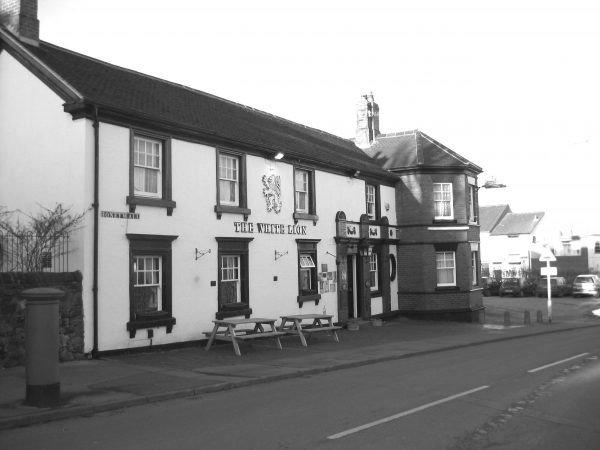
Thomas Appleton had established himself as a property owner as early as 1762 and was involved in numerous mortgage transactions over the following years, mostly concerning three cottages and stables, two of which were rented out while he occupied the other. Although no direct name is given to the property, I think it safe to assume that these three cottages would be the origins of what is now the White Lion Inn of today. The view from the front of the inn points to the conclusion that this could originally have been three cottages later converted into one.

In 1861 it was owned by Richard Stone who sold the plot of land at the rear of the inn to Frederick Bishop to enable a new road to be built from Honeywall to Princes Road, thereby opening up the area for housing development from 1865. Note the name Stone Street.

Probably as a direct result of the development of the nearby allotments housing estate towards the end of the 18th century, The White Lion was extended as can be seen from the red brick addition. By 1914, the inn was occupied by Harvey Howell, and owned by Burton Brewers, and described as the White Lion Inn with stables and garden. The annual rent paid by Mr Harvey amounted to £60, and the rates amounted to £48. If compared with those of The Beehive, it is obvious that The White Lion was a much more substantial establishment than The Beehive just across the road.

Compare

Meet The Author

The White Lion Inn was first licenced as an Inn in the last quarter of the 18th century and not a Beer House meaning that it could serve travellers with wine and spirits as well as beer following the steep climb up Honeywall with a number of pack-houses carrying ware from the pot-banks of Stoke to the south for sale. Again, it’s an interesting tale of various landlords and relationships and the development of the site which once had a huge bowling green to the rear.

In 1861 it was owned by Richard Stone who sold the plot of land at the rear of the inn to Frederick Bishop to enable a new road to be built from Honeywall to Princes Road, thereby opening up the area for housing development from 1865. Note the name Stone Street.

Probably as a direct result of the development of the nearby allotments housing estate towards the end of the 18th century, The White Lion was extended as can be seen from the red brick addition. By 1914, the inn was occupied by Harvey Howell, and owned by Burton Brewers, and described as the White Lion Inn with stables and garden. The annual rent paid by Mr Harvey amounted to £60, and the rates amounted to £48. If compared with those of The Beehive, it is obvious that The White Lion was a much more substantial establishment than The Beehive just across the road.

Reviews

There are no reviews yet.

Be the first to review “inn 6 The White Lion Inn, Honeywall”

Your email address will not be published. Required fields are marked *

Select at least 2 products
to compare