The full record of all burials in the Church of St. Thomas, Penkhull from October 1844 to the last in 1943
This is in spreadsheet format on Excel so seasy to search names. A great help for people working on their family tree

£4.00
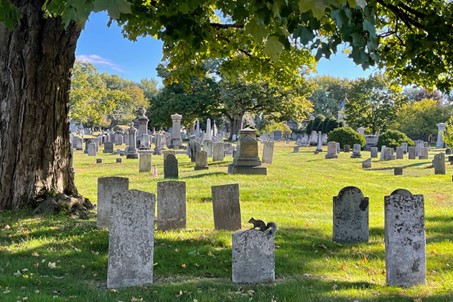
A full record of all burials in the churchyard of St. Thomas, Penkhull from 1843 to 1943
A great help for people researching their family tree
Elzel format on a spreadsheet
The full record of all burials in the Church of St. Thomas, Penkhull from October 1844 to the last in 1943
This is in spreadsheet format on Excel so seasy to search names. A great help for people working on their family tree
A pie chart and list of three different denominations withinStoke-upon-Trent as recorded in the religious census of 1851
The first production entitled Snow White, and the Seven Dwarfs was staged in 1958, and was presented almost in a makeshift theatre in the upper schoolroom of the Sunday School. Because of its huge success and public praise, it was decided to present the panto in what was then called Penkhull Senior School the following year. The new venue had a large stage and many schoolrooms that could be used for dressing and props. The next production, Cinderella, surpassed all expectations and the mould was set for an annual pantomime to be presented the week after Christmas. Mrs Buxton continued to produce for three years and was followed in that important role in 1962 by Mrs Betty Powell, by which time the organisation drew in many helpers to build the props, install the lighting, and paint the scenery from both chapel members and the local community. My mother-in-law, Meg Palmer, took charge of the costumes; Dennis Cotterill the lighting and electrics. Other helpers in those early days were Mrs Marjorie Prophett; Mr and Mrs Tom Rowley; Frank Adams; and Jim Powell who helped to produce the props. A story that will bring back so many wonderful memories both of the pantomimes but the people involved.
Three pages with loads of Panto photographs.
The burial register of St Peter ad Vincula Stoke from 1703 – 1752
Set in Excel format spreadsheet
Following the end of the First World War every village, town and city in the land discussed a memorial to those who had given their life in the Great War. Some created civic memorials in front of town halls some were erected in Parks and Churchyards and others took other forms of remembrance. At Penkhull it was agreed that this should be in the form of a Rood Screen.
It waas this national movement to remenber those who died that prompted Penkhull Church to consider which was an appropriate memorial and worthy of the sacrifice of so many lives and the desire to express thankfulness to Almighty God for allowing Britain to achieve victory.
Plans were drawn of the proposed designed and distributed to every household within the parish. The scheme costing £950 well over £275,000 in today’s money. A Mural Tablet, it was said would be situated near to the Rood listing the names of those who had made the ultimate sacrifice. The plan also included new choir stalls. It was thought that if every household promised to contribute just one guinea that the scheme would become a reality. The project was ‘to the Glory of God, in memory of the brave fallen and as a thank-offering’. As a result volunteers would visit each home to collect their weekly donation of just 3d a week for twenty weeks, such was the poverty in the 1920s.
This fact points to the situation of Church as being a site for early Pagan worship and chosen clearly for its direct location adjacent to a ford across the River Trent. It is from this period that this short account commences which include notes re the first Saxon Church, its dates, history, description followed by the Norman Church which hand in 1876 the two Norman arches re-erected from their remains were found in the water flow to the Rectory Mills.
It continues to describe the churchyard and its history of important graves, the ancient parish registers and Stoke Hall the first rectory with a moat around it and loads more. Nine Pages A4 with lots of photographs.
If you are interested in the background of religions in particular the Anglican and Methodists and their origins this 5,000 ples words is a good start in understanding the growth of two quite opposing religions of the time. The early nineteenth century, an age of mechanism, seemed to muster that unimproved concern at the death of the spirit that was the parent of romanticism. The Anglican Church, conscious of decline, made stringent efforts to reverse the situation by the provision of new churches. The urban working classes, largely alienated, became increasingly apathetic to churchgoing. In many cases people who had been uprooted from their country parishes, by coming into new urban centres in search of employment, became indifferent to religion. Social mobility and demographical increase often left them outside the scope of the established church, a situation made worse by the emergence of the dissenting sects.
After the war with France and the defeat of Napoleon in 1815, the British people of all classes expected a period of prosperity. Times were hard however as there was no improvement in conditions of employment for the next seven years. K.S. Inglis attempts to put churchgoing into perspective. During the nineteenth century, the habit of attending religious worship was not normal among the working classes. From the beginning of the century, the spiritual destitution of the lower orders was a commonplace of discussion.
This is a brief outline of the essay but sets the picture of what follows. A great read for all keen to learn of the issues seperating two churches in the village of Penkhull.
Ten pages with 5,000 plus word content.
Select at least 2 products
to compare


Reviews
There are no reviews yet.