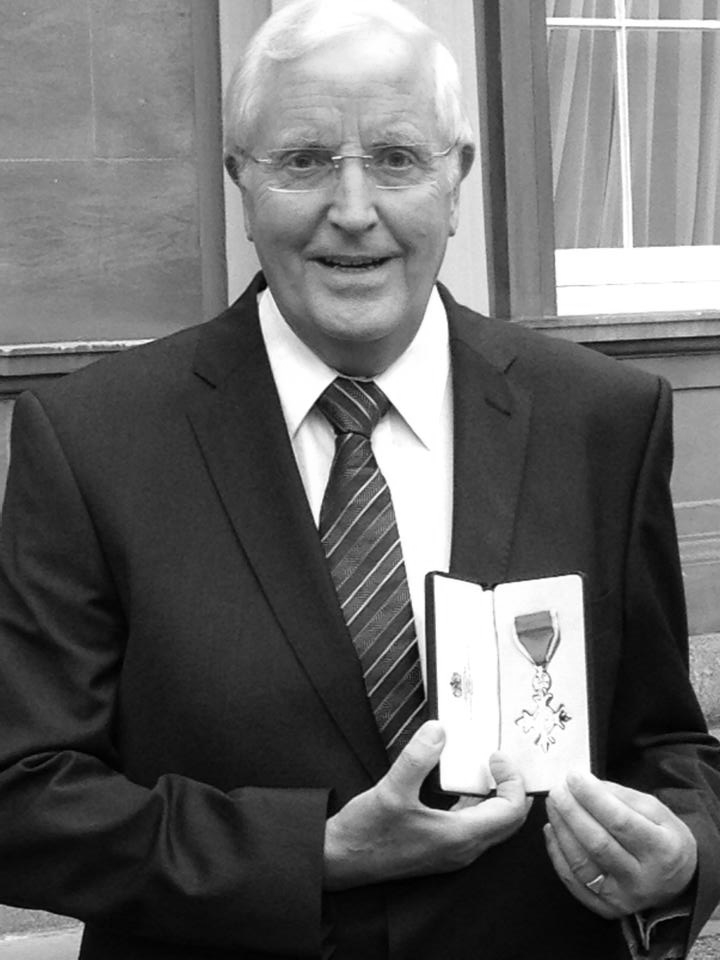
Richard Talbot

The profile of Richard Talbot reflects life of being a child following the end of the Second World War a period of difficulties and a ‘make do and mend’ philosophy.’ It identifies the ingenuity of young children with little or no pocket money. It also illustrates how as a young child Richard, along with his two brothers had to help with many household chores including fetching coke from the gas works on a Saturday with just an old pushchair to carry it back home with. All this with no TV, only an old radio, just a coal fire so no central heating, toilet down the yard which until the age of around nine was a Duckett lavatory until water was piped down the yard to provide a flush toilet.

Author's books

mis 24 Queens Hotel, Hanley and why it was short lived?

£4.00

My guess is that few in the city are aware that Hanley Town Hall has become redundant because of council services being amalgamated with better use of council stock. This prominent Hanley building became a town hall in 1886, prior to which it was the prestigious Queens Hotel. Sadly, for a combination of reasons its life as a hotel extended just less than twenty years, but no one has over the last one hundred and forty odd years explored its demise, and yet its short life is full of intrigue and wonder as to why the most attractive building in North Staffordshire closed its doors.

The need for such a hotel came about because from the late 18th century, the combined townships of Hanley and Shelton were rapidly expanding with Hanley as the central town of the six and where most of local business was conducted and meetings were held.

In 1857, because of its growth and importance, the township of Hanley with Shelton become the first incorporated borough of the six towns leaving the other five behind. It became the prominent town of the Potteries where its leaders and influential businesspeople were set on a course for Hanley to become the central and most important town in North Staffordshire.

With its new-found status of a county borough, the town council and leading citizens came to realise that to attract new business to the town that a hotel which outshone all others was important to its growth. As a result, they came together to form the Hanley Hotel Company in July 1864 offering four thousand shares at £5 each for sale. Hanley, they declared was the centre of the Potteries and frequented by china and earthenware dealers, commercial travellers and as such there was an urgent need for public functions and superior accommodation associated with a progressive town like Hanley. Indeed it was the most impressive hotel in all of the potteries six towns.

This four page history identifies the trials and tribulations that fell onto the Queens until it was purchased by Hanley Borough Council. A further good read of how a depressed financial state of the period can loose such a building. Four Pages.

mis 25 The Regent – Talkies arrive in the Potteries.

£2.00

The cinema was operating silent movies when it opened. At the same time a debate was being held between film directors and actors if to proceed with ‘talkies’ because of the costs and wondered if they would oust the silent picture or even rival the appeal of the theatre. It was only two months following the opening of the Regent that the cinema along with a further sixty of the Gaumont circuit cinemas were equipped with the Western Electric Company’s talking film installation whereby full-length films such as “The Singing Fool” and “Show Boat” could be shown.

The Regent Theatre in Hanley was opened in 1929 and waas the largest and most lavish seating over two thousand partons. It was not long after that the very first ‘Talkie’ in the Potteries was shown at the Regent in July 1929 when “The Singing Fool” starring Al Jolson took to the screen filling the 2134 seats at four performances a day. At the end of the week the demand was so great with constant queues around the block that the management decided to run the film for a further week. This meant that around 26,000 people came to see history in its making at The Regent and to witness actual words and music coming for the first time from actors. I doubt if there was one dry eye as he sang Sonny Boy. The Sentinel reported “Whenever it has been shown enormous crowds have been drawn to see it. It is a remarkable production and has secured almost universal approval. In it Al Jolson is revealed as one of the most powerful emotional actors on the screen”.

Two pages long

mis 26 Roman Stoke – the evidence explored.

£2.00

This article includes all the known ‘finds’ dating from the first century AD within the area known as Stoke-upon-Trent.

In the late 1920s and early 30s there were numerous Roman finds in the area, mostly documented by the late Thomas Pape of Newcastle. It was a further twenty years later in July 1955, when a group of volunteers excavated a series of trial holes in which Pape had worked. Two excavations were made, the first showed signs of occupation as a post hole were discovered. Adjacent to this lay a charcoal deposit, intermixed with pottery sherds and on the floor lay pottery consisting of lamp-holders, cooking pot lids, platters, flagons, and an incense burner. A crude hearth was found together with an iron poker. The pots were fashioned from local clay but at this point no kiln was unearthed. It was possible to deduce that the post holes supported a wattle and daub structure and with the profusion of potsherds, indicated a potter’s workshop. The building it would seem had been burnt to the ground suggesting a sudden vacation of the site perhaps the rebellion of Boudicca (A.D.61) demanding the return of all Roman outposts. Two x A4 pages and photographs.

mis 27 Stoke Wakes – the Annual Potteries Knees-Up.

£3.00

By the 1840s the annual Wakes festival became an intrinsic part of the Potteries calendar as each town was described as “full of jollity”.

The “wake” of the Parish of Stoke  in 1847 was, in reality a continual series of pleasure fares, and merrymaking, for the towns of Stoke, Fenton, Longton, Hanley and Shelton. Even by then Hanley had become the centre of attraction. Here were tents, sideshows, stalls, food, and drink outlets and shows with performances every thirty minutes with their own individual gimmicks to attract a person to spend just 2 pence.

It was until recently that it was fashionable for those considering themselves the ‘upper classes’ of society to speak of the sovereign people as the “unwashed”, but in the potteries save and except stray collier in his working dress it would be difficult to find a man, woman, or child, when from their employment, with an unwashed faces or unclean hands as they are all well dressed and scrupulously clean in their Sunday best as they promenaded around town centers and above all wanted to be seen as such. Four x A4 pages full of atmosphere.

mis 28 When Stoke nearly lost its identity to Newcastle-under-Lyme in 1831.

£2.00

The thought of Stoke town being transferred to Newcastle in 1831 nearly happened.

The 1830s was a critical time in local and national history with Parliamentary reform top of the agenda. In March 1831, a proposal to abolish the old system of parliamentary elections and to make the voting system dependent upon a £10 per annum rental value of household property to qualify for a vote and then only for men which became the Reform Act of 1832. There was no representation of the six towns by an M.P. The Borough of Newcastle had one. Within the proposed John Russell’s Reform Bill, it empowered a commission to add populous districts such as the six towns to existing Boroughs.

Leading business men in the town including Herbert Minton thought that Stoke would prosper far more by being part of Newcastle.   Boothen and Penkhull (Stoke-upon-Trent) would be transferred to the Borough of Newcastle-under-Lyme . A a public meeting held on April 6th 1831 in the old town hall in Hill Street.

It was first suggested that the proposal for uniting Stoke with Newcastle would be in opposition to the wishes of the Burgesses of Newcastle. The only benefit, as advocated to Stoke was that it would provide an effective police force and a local magistrate. Also, there was the advantage of the union with Newcastle. The debate continued with one speaker after another. Large numbers tried to get into the town hall, so the meeting tyransferred to a piece of aloping ground just above. One page only but worth a read to follow just what could have happened that would affected the development of Stoke on Trent as a whole.

mis 3 Canada Cottage, Penkhull – appearance of a Well in the kitchen

£2.00

In an old cottage found in Canada Cottage, Queens Road, Penkhull Stoke-on-Trent dates from 1814 during renovation of the kitchen, unearthed as a large deep well with water running through the bottom.

The well is 9m deep and is brick-lined in a manner that I’ve seen in other examples of the 18th and 19th centuries. Stylistically, the bricks appear to be no earlier than the late 18th century, but, equally, could be early 19th century in date. The owners pointed out a small number of pottery sherds that had apparently been found above the sandstone slab used to cap the well – most of these pieces were early-mid 19th-century in date but offer somewhat iffy dating evidence as they’re essentially unstratified finds. Since the find the current owners have made this into a feature of the house, Not only is it now flood-lit it has a plate glass top cut to size making a feature many others residents in the area would like Certainly worth a read.

Two pages with a number of photographs.


mis 30 The Barracks at Newcastle started as a militia stores.

£3.00

Origins of this old building, the Newcastle under Lyme Barracks is reminiscent of a buy-gone age and remains much as it was when built. The first mention of significance is found in Keates Directory of 1882/3, nearly thirty years after the date that it states the barracks were built – 1855. An opening of a donation list commenced with the donation of £100 from the North Staffordshire Colliery Proprietors followed by numerous pottery owners and people of importance totalling twenty-eight who donated a total of £595, a huge amount in 1842.

Moving on in 1881, there were eleven resident families under the leadership of Sergeant Major William Dickinson, 3rd Staffordshire Militia, aged forty-nine, and his wife Mary aged forty-three occupied No.1 The Barracks. They had four children, the eldest was James aged fourteen, a tailor’s apprentice in the town. There were two families with five children, Joseph Payne, aged forty-three, Colour Sergeant 3rd Staffordshire Militia, and his wife Jane and five children aged from ten months to eight years. The second was John Walton, Colour Sergeant 3rd Staffordshire Militia, aged forty-two and his wife Jane aged thirty-five. Their children were aged from one year to 13 years of age.

Its a facinating study to read of its development from 1855 until the Militia finally left the barracks.  Four pages long and a facinating read of an important feature of the town of Newcastle under Lyme.

mis 4 Chloroform used first in the country at Etruria Hospital.

£2.00

Quite by chance I came across an article dated 26th December 1846 which pre-dates the official published date of 1847. In the article recorded in the Potteries Mercury it first acknowledged the work of Prof Simpson, who had demonstrated chloroform for its anaesthetic properties on humans but in fact had applied numerous experiments on himself and others first which gave rise to its rapid increase by the of the medical profession in favour to that of ether. The interesting fact remains is that surgeons at Etruria had performed operations with the use of chloroform several months prior to the work of Simpson being published, such was their skill of administering the drug resulting in a number of successful operations. Two pages

mis 5 Doncaster Lane Penkhull where the pottery Willow Pattern was designed.

£2.00

Samuel Doncaster, (1772-1842) originating from Stone. He had two brothers, Henry, born 1768, and the Rev John Doncaster, born 1769, who resided at Newcastle. Samuel and Henry were both engravers and worked together at the workshop in Swynnerton ‘s Lane, Penkhull. They employed three people, Hancock, Greatbatch and Smith. Greatbatch went on to work for Mr Minton and Smith for Mr Spode (note Greatbatch Avenue). Brothers Henry and Samuel produced work for Spode, Minton, and Davenport.  Henry Doncaster assisted another engraver, Mr Turner, in the development of the plates for the Willow Pattern for Mr Minton. In the account books of Minton there are numerous entries of payments to Mr Doncaster for work conducted on their behalf. In recognition of the work undertaken by Henry Doncaster, Swynnertons Lane was changed to Doncaster Lane.

Far more details in the three page artical including photographs of the Lane.

mis 6 Employment of Children in the 19th century potteries.

It is impossible to make comparisons today for the working and living conditions of the middle years of the 19th century and yet it was a reality of life not to be brushed under the carpet. Without exception, the vast majority were either potters or colliers in every town of the Potteries and the challenge to the working class was to avoid the workhouse at all costs.


The causes of such depravity are numerous, the pottery industry was unpredictable especially with the USA market. Breadwinners, because of the payment system of wages being paid in the corner pub were encouraged by the landlord to have more to drink as he claimed had not enough change to pay them from a £5 note from the foreman who held the pay for all under him. Many wives, along with their children would stand outside imploring their husbands to come out before all their wages were spent but to return home with drunken spouse with the certain knowledge, they would be evicted the following week as there was no money for the rent or food.A true reflection of life in the pottery towns ideal for the study in Humanaties. Nearly 1800 words x three pages.

mis 7 Fatal Duels

£1.00

Guilty or Not Guilty that is the question or does a Duel prove who is or who is not?

Searching through my archives of the Potteries Mercury for 1830, I came across a most interesting account of a duel taking place in London but what made it special was the behaviour of both parties following the outcome of the duel but also the inquest that followed.

Duelling had been the way officers and gentlemen settled matters of honour for centuries. Up until the mid-19th century there were situations where a meeting with pistols or swords was seen not just a possible response to a perceived insult, but the only honourable one. Men risked being ostracised from society for not issuing a duelling challenge in response to an insult. This is a true story. An introduction to a two page facinating artical of the once popular was of resolving and argument or a public insult. two pages.

mis 8 Garden Street Penkhull – An early Spode housing development.

£2.00

In May 1810 Spode proceeded to develop further workers’ dwellings in the village of Penkhull. He acquired two sites with existing properties owned by Thomas Chapman, a resident of Penkhull, The first site contained five old cottages described as being the inheritance of Joseph Bourne and afterwards his sister Margery Chapman. These five cottages stood in what was Farm Lane and were either demolished or converted into six cottages by Josiah Spode.

The new or converted cottages were built in a similar layout to others built by Spode, two up and two down. At the rear was a communal yard with shared privies, ash pit and one shared water pump. Even with the lack of facilities compared with other houses built by Spode, the occupants were charged the same rent at 8s 9d, per week subsequently creating a high turnover of tenants as it was a large sum to find.

Originally called Farm Lane as Penkhull Farm was almost opposite, but like many streets in the 50’s the name was changed to Garden Street as opposite were allotments.

The last cottage was converted into a Beer House, converting the front room to accommodate as many as possible. Again, a good read for anyone at college and taking Humanities. A great read of life then two pages with photographs.

mis10 High Pollution cause early deaths in the potteries.

£2.00

High pollution caused early deaths in the Potteries.

The killer-smog of the potteries – average of death for men c1900                     aged thirty-four.

At one time every breath taken in the smoke polluted atmosphere of Stoke-on-Trent could bring you closer to death. Richard Ault looked at what it was like to live among the smoke and smog of the potteries at 150 years ago.

Generations of potteries grew up constantly surrounded by the thick, flowing smoke and smog which was as much part of the skyline as the bottle ovens. But the acrid, choking smoke that was pumped out into the atmosphere from the factories was more than just an inconvenience to housewives hanging out their washing. In fact, this killer cloud was so striking that even Karl Marx referred to the appalling chest diseases while visiting the area in the 1860s.

In 1891 an incredible 40% of all deaths caused by respiratory diseases. On average, men would die a month after retiring at 44, although women could expect a wheeze on to reach the ripe old age of 48. The London journalist and author James Greenwood was astounded by the grimly atmosphere when he visited the potteries around 1875.

A great piece of research to show how severe life was in the Potteries. Good article for students of health, living conditions and humanities. two pages.

mis9 Greyhound Inn – King Charles 1 visit.

£2.00

Over the last fifty years I have acquired and transcribed what has become the only and largest collection in the world of the Manor Court Rolls of Manor of Newcastle-under-Lyme which included what is two thirds of Stoke-on-Trent from 1347 – 1927. It is from this extensive archive that an account appears of King Charles II visit to Penkhull.

Following the demise at the castle at Newcastle all manorial courts were held once every three weeks from c1530 in a large farmhouse in Penkhull and what is now known as the Greyhound Inn. No doubt many readers will know that Major General Thomas Harrison, the second in command under Oliver Cromwell was the son of a butcher and born in High Street Newcastle, the site of which is now occupied by the HSBC Bank. There is a brass plaque on the wall to this fact. It was Harrison with others who also signed the death warrant of Charles I.

During the Commonwealth period 1649-1660 Cromwell was designated the Lord Protector and appointed Harrison as the head of the former Royal Manor thereby receiving all rents and court dues. He is frequently mentioned as attending as head of the manor in the court rolls.
After the Restitution of Charles II, Thomas Harrison was executed on Saturday 13 October, 1660. Then Charles ll stayed at the Greyhound Inn whiles intending to do retribution against the family of Harrison – compelling story. two pages

mou 2 The Mount, a history of the home built by Josiah Spode.

£5.00

The history of the new family home of Josiah Spode II, The Mount built in Penkhull in 1808 and still stands as a testament to his wealth of a potter. The beautiful dome covered entrance stand proud as it overlooks Clayton and Newcastle under Lyme, and importantly away from the grime and smoke from the town of Stoke, where his factory stood and contributed to the serious issue of pollution of the area.

This is a comprehensive history, covering many documents, photographs, sales documents and contents as well as details of the Mount Farm and the importance of its location. From the death of Spode in 1827 the story continues with the number of tenants who occupied the home from pottery manufactures, a girls posh finishing school, a home to one of Stoke on Trent leading solicitor Mr. Frederick Bishop who sold of much of the land. A huge amount of original research has gone into this over a long period of time and is a much-valued contribution both to the social and economic history of the area but to the important development of Penkhull itself from around the 1870s.

twenty four pahes including phiotographs

mou 1 Girls Finishing School at The Mount.

£2.00

The 1851 census provides and unique account Mrs Allbut’s Ladies Finishing School which occupied the Mount from that date. Again, much material has been un-earthed to capture and provide an insight of its development; problem with having a son in a female institution; fees; lessons taught and where the ladies came from – one even from Calcutta. A great contribution to the history of the largest house in the district and a good product to stimulate discussion is schools or colleges. Three x A4 printed pages.

1 4 5 6 8

Select at least 2 products
to compare