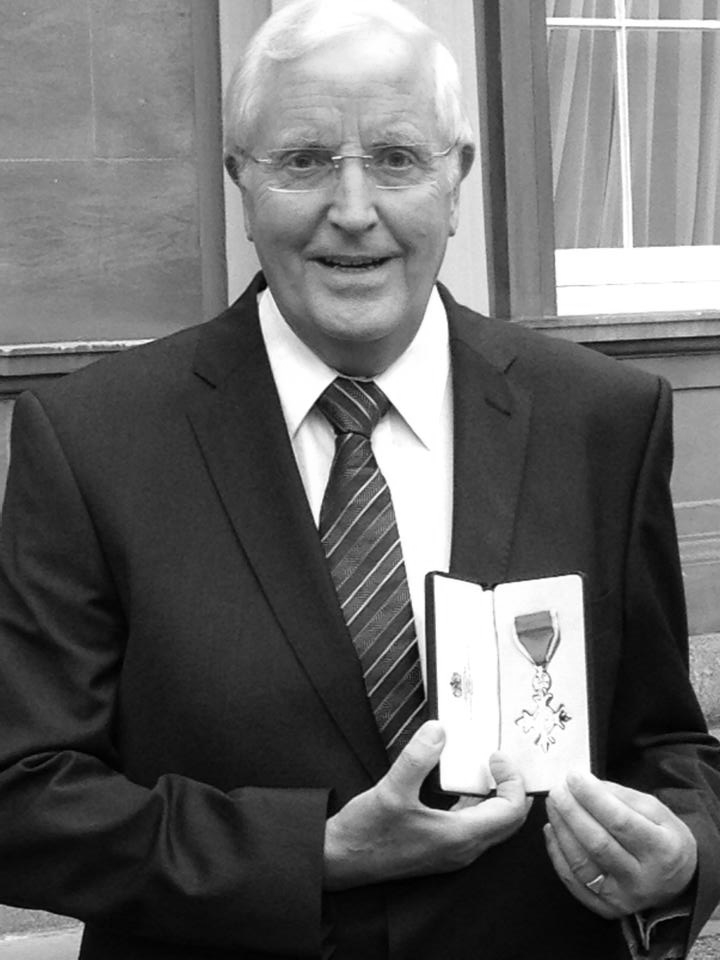
Richard Talbot

The profile of Richard Talbot reflects life of being a child following the end of the Second World War a period of difficulties and a ‘make do and mend’ philosophy.’ It identifies the ingenuity of young children with little or no pocket money. It also illustrates how as a young child Richard, along with his two brothers had to help with many household chores including fetching coke from the gas works on a Saturday with just an old pushchair to carry it back home with. All this with no TV, only an old radio, just a coal fire so no central heating, toilet down the yard which until the age of around nine was a Duckett lavatory until water was piped down the yard to provide a flush toilet.

Author's books

min 2 Thomas Minton, Master Potter – the wider picture.

£4.00

The 1790s was a time of major changes to the geography of Stoke with the cutting of two major transport facilities, first the turnpike road to Hanford (London Road) and then the canal from Stoke to Newcastle both opening up development opportunities in town. But first he had to grasp the opportunity to set up his own works as an ideal plot of land in the town of Stoke became available in 1793.  It was in London Road with a good turnpike road. Later with a new canal the Stoke to Newcastle canal gave him direct acsess direct into his new factor in London Road – both for expoerts and the unloading of raw materials.

In 1796 Minton went into partnership with Joseph Paulson who was already producing china (porcelain containing bone ash) at a factory on land he purchased in 1792  just across the road from Minton.

The artical then continues with other partnership and the development of some of his best known early products. Thomas had two sons Thomas and Herbert both being taken into partnership. Thomas Webb decided to enter holy orders and in 1821 left Stoke. The title of the company known as Thomas Minton and Sons was dissolved and reverted back to the form of Thomas Minton. The termination of the partnership was brought about by the desire of Thomas Webb to study for the church.  Subsequently, whilst he was the Rector of Durham, he gave the sum of £2,000 to be invested to provide a salary of a priest for the newly parish of Penkhull. It was his son, Samuel Minton who became the first incumbent of Penkhull Church.

Enough for now but this piece is just a shortened version of how the full article moves on to discribe the life of Thomas Minton. Three pages and photos.  Three x A4 pages

mis 1 A Personal prospective of post-war family hardships.

£1.00

Probably the most significant thing for the immediate post war years was rationing and little money. For families it must have been especially hard for mothers and hardships continued as for a decade following 1945. What is more surprising they are all within a person’s lifetime and have no relationship to present-day austerity.

As children we only had new clothes at Eastertime and these were purchased from the Co-op Emporium in Liverpool Road, Stoke, with the ‘divvy’ mother received on what we had spent at the co-op over the year. I was totally fascinated by the overhead wires carrying the Dart Cash Carriers from every corner of the store to a central elevated cashier’s desk.

Just a short part of an interesting view of life in the early 1950s. 2 pages

One of the highlights was when our landlord Mr. Bourne decided it was time to replace the ducket lavatory with actual clean fresh flushing one. The whole yard was dug-up for a water supply from the kitchen. I could not believe it; it was flushed with clean water you could drink – such wonders of the world I thought. But having water laid on brought a whole new set of problems in the winter months with freezing. Old rags were used as lagging to wrap around the pipe, but this was not sufficient. So, in addition a paraffin lamp had to be secured and placed by the pipe to keep the water from freezing ultimately leading to a burst-pipe and possibly no water for weeks.

mis 11 Highway Robbery in North Staffordshire

£2.00

My guess is that the words ‘highway robbery’ or ‘stand and deliver’ conjure up words that belong to the past and probably have little equivalent in use today. However, in the 17th and 18th centuries they were frequently used so was ‘money or your life’. There was however a distinction between ‘highway robbers’ who were people on foot, whereas ‘highwaymen’ were on horse-back and promoted by the most famous highwayman of all Dick Turpin. Turpin had a short life of thirty-four years 1705-1739. He was the son of an alehouse keeper, and apprenticed to a butcher, but later known for his cattle stealing. He joined a notorious gang of deer stealers and smugglers in Essex later turning to highway robbery in Lincolnshire with his partner Tom King. After shooting his partner by accident he fled to Yorkshire and changed his name. In 1739, he was caught and jailed for horse theft in York.

The thought if Dick Turpin could be duplicated, yes his rewards would be far greater that those of North Staffordshire where you would rob and receive severe custodial punishment for just a silk scarf or a sheet. The author uses accurate press reports to illuminate life and the consequence. A great read and an asset for school, colleges or humanities. Three pages. Nearly 1500 words.

mis 12 A brief introduction to History and Archaeology of Stoke.

£2.00

Stoke Market, built in 1900 still dominates the central section of Church Street. It is of red brick in the Flemish style with curly gables and a central tower. Next to this stood the former National Provincial Bank dating from the 1890’s built also of red brick in the Jacobean style. The opposite side of the road there is a mixture of properties, but mostly of the mid-late 19th centuries for which the upper floors still retain the original architecture.


The history of Stoke-upon-Trent is interrelated with the parish church of St. Peter-ad-Vincula. It is known that there has been a church on this site from 805a.d. but probably was a firmer site for Pagan worship.

Prior to the coming of the industrial revolution Stoke was the place where the parish church, rectory and parish clerks house was situated. There were no other buildings in the immediate vicinity except an old Inn known by the sign of the Red Lion. (now demolished).  In 1296, Stoke was the joint largest parish in the country and lates there became a number of Chapels of Ease dotted around North Staffordshire but remained under the authority of the Rector of Stoke. They became separate parishes by an Act of Parliament in 1807 as the parish was becoming too burdensome for a single priest and a curate.

Stoke town formed a part of the Township of Penkhull with Boothen until it became a Borough in 1875.  From early times, the inhabitants of the township did not live in Stoke town, but in either the small hamlet of Boothen, half a mile to the South or the larger Domesday Village of Penkhull standing high above the town to the Southwest.

This article is packed with date from 1807 and follows through with details of the towns development to become a commercial success with the building of a Town Hall which still remains the base of authority but other advances such as the public market and so many other examples of early developments during the 19th century. Again, a good read but also an asset for students of all levels.

mis 13 Honeywall Penkhull origins of name.

£2.00

For those coming up the hill to Penkhull from Stoke, the question was where did Stoke end and Honeywall start?  In fact, the name of Honeywall, a rather strange name, did not start from the bottom as it does today. That area was originally called Castle Cliff- changed to Cliff Bank. The next higher section was called Upper Cliff Bank followed by Princess Street before being known the whole length by the name of Honeywall. The name of Castle Cliff is really important and yet there is no evidence to support this name of a castle at the top of the hill. Perhaps this explains why parts of what Honeywall is now went by the name of Castle Cliff. Food for thought! The area known as Honeywall commences from just about where the Beehive now stands to its junction with Penkhull Terrace and in fact refers to the hamlet of Honeywall and not the road name.

To add even further to the mystery in 1870, whilst digging near to the White Lion an ancient boulder pathway was found.  Could this have any connection with some form of early settlement? 

Rev.Aston, in his little book of 1942 suggests without any evidence to support his claim that it could mean Hole in the Wall, pointing to a possible wall around the ancient royal forest where a hole in the wall was used for game hunters!  But in saying this there is an argument presented to that part of Honeywall being the boundary of the once Iron Age Fort that capped the hill of Penkhull. Why? We have the name of Castle Cliff, and we have the evidence of a boulder pathway being uncovered outside the White Lion.  Also, the name of Honeywall could derive from the old English – ‘hill fortress’ and lastly, it’s the name given to a small hamlet not a road.  People would be known by the place where they lived (not a street name, but a district) and the name Hole in the Wall, the entrance area of the hill fort, could be just that place where a group of small traders resided. Lastly, it was recorded in the 19th century that beekeepers were resident in the area, so could the name originated from there? The Bee Hive Inn could be named following the known occupation of Bee Keepers in the area. A further conundrum. Two pages and photographs.

mis 14 Majestic Cinema Stoke-upon-Trent. A history from 1912

£2.00

The formal opening of the majestic, the latest picture house in the district situated in Campbell Place Stoke was held before a large invited guest list.in . The building is architecturally admirable, ihaving  so many advantages over other buildings used for the same purpose that it is certain to become extremely popular place of resort.

A gallery, holding around two hundred, is so well pitched that every seat holder can be sure of an uninterrupted view of the screen, and at the same remark applies to the holders of eight hundred seats on the ground floor. The seats themselves are exceedingly comfortable, and there is a roominess about the place which will be generally appreciated. In another respect the architect Mr R T Longsden of Stoke and Burslem is to be congratulated. The building is splendidly ventilated. Notwithstanding the crowded state of the hall the atmosphere on Saturday afternoon remained practically the same throughout the 2 ½ hours that the entertainment lasted. Early in the proceedings a message was thrown on to the screen from the Mayor and Mayoress, (Alderman Philip Elliott and Mrs Elliott), were spending a short and well-earned holiday in Harrogate, expressing regret of being unable to attend, and successful future. One feature which is to distinguish the house of entertainment will meet with public recognition. The management has engaged a small band consisting of a piano, a violinist, a cello player, a clarinettist, and a double bass player. The men are very capable players and have good instruments. On this occasion, they provide music which synchronised with the picture subjects. Thus, during the exhibition of the principal film, a four-part historic picture ‘Napoleon,’ the band played the Marsellaise and snatches of the famous 1812 of Tchaikovsky.  The pictures also included the Kentish industries, Tiny Tim, the Letter Writer – a drama, With Eyes, so Blue and Tender, Troubles of a flirt, That Suit So blue, General Bunco’s victory and the Pathe Gazette. Tonight, will be given exclusively a sporting drama, in the hands of London crooks. One additional feature of the new cinema that it had tip-up seats. A nice piece of Social History at 1000 words in two pages with photographs.

mis 15 Malcolm Campbell’s Bluebird 1935 stored in Stoke during WW2

£2.00

Bluebird 1935 land speed car in storage at London Road, Stoke during WWII.

The resurgence of the name Bluebird as the speedboat in which Donald Campbell was killed in 1967 as it crashed on Coniston Water in his attempt to break his own water speed record and now following years of restoration following its being brought to the surface years after the crash has once more finally been tested in the water.

His father, Sir Malcom Campbell was a British racing motorist and motoring journalist. He gained the world speed record on land and on water and holder of 13 world speed records during the 1920s and 1930s.

Campbell broke the land speed record for the first time in 1924 at 146.16 mph at Pendine Sands near Carmarthen Bay in a 350HP V12 Sunbeam, now on display at the National Motor Museum, Beaulieu. He broke nine land speed records between 1924 and 1935, with three at Pendine Sands and five at Daytona Beach. His first two records were driving a racing car built by Sunbeam.

I wonder if there is anyone reading this who remembers the car in storage at 245, London Road as it would be great to receive their memories. Two pages of the life of Malcolm Campbell.

mis 16 Margaret Leigh – the Burslem Witch.

£2.00

The name of Margaret (Molly) Leigh of Burslem has been vilified by the press and so-called amateur historians who have taken pleasure in perpetuating the myth that she was actually a witch coming up on a regular basis.

Hardly a month goes without a further slant has been added to these ridicules theories in attempt to draw attention to the writer as an authority where history is concerned. Nothing could be further from the truth.

So, in attempt to place on record the actual FACTS I have studied these and present and with my own research provide a true account re Margaret Leigh the supposed witch buried at St. Johns, Burslem 1st April 1748 and the copy of her will dated 25th March 1748 written just one week before her death. In my experience over many years this was normal practice. The explanations I give destroys all the exaggerations and wrong information in an attempt to be known as an authority on the subject and further stretch the imagination to include their theories.

This article is there for all to make up their own mind on this subject. Two pages

mis 17 Hartshill Church, built by Harbert Minton, 1842 the Consecration

£2.00

This beautiful building of Holy Trinity, Hartshill was opened on Monday, 10 October  1842. From an early hour Hartshill was crowded by of what were called at the time “respectable visitors” wishful to attend the ceremony of consecration.  At 11 o’clock, the Bishop of Hereford arrived by which time the clergy of the neighbourhood, and many from a distance had been in attendance to receive his Lordship. About fifty members of the clergy were present.

The arrival of the Bishop was the signal for a procession from the main road the church drive and into the church. The children of the infant’s school headed the procession, immediately followed by the bishop and clergy; after whom came a vast body of ladies and gentlemen who took an interest in the proceedings. The entire number was calculated at above 2000 people very many more than the church could contain. Notwithstanding the solemn nature of the ceremony, the great admiration excited by the architectural beauty of the building caused a sense of admiration by the gathered company. The consecration service was conducted impressively after which the Rev C. Leigh of Newcastle, preached the sermon from Romans “for whosoever shall call on the name of the Lord shall be saved. How then shall they call on him whom they have not believed? And how shall they believe on him of whom they have not heard? And how shall they hear without a preacher? And how shall they preach except they be sent?”. Sermon was considered most appropriate by the congregation and the greatest expression was shown by all to the benevolence of the worthy founder of the church Mr Herbert Minton.

Hopefully this account will prove to be welcomed by the current residents of the district as a reminder of just how Hioly Trinity Church, Hartshill was indeed a great asset to the district. One page

mis 19 Newcastle Canal, from Stoke to Newcastle under Lyme.

£4.00

Although this article is a history of the Newcastle Canal its origins stem from the opening of the Trent and Mersey canal in 1766. It’s from this time that the industrial revolution in the six towns took off as this new mode of transport from roads to canals.
It enabled raw manufacturing materials and coal delivered almost to the door at a smaller cost, quicker with less damage to good than previously. This advantageous mode of transport gave an urgency to extend its waterways for others to take advantage of increased sales at lower costs. One such emphasis was to create a branch from the Trent and Mersey at Stoke through to the town of Newcastle-under-Lyme to bring coal from the mining village of Silverdale to markets both in the Potteries and further afield. And in addition to bring much needed materials to the manufacturing town of Newcastle under Lyme. In 1795, the year of Wedgwood’s death, this new canal was cut from Stoke to Newcastle but because of the hills of Penkhull and Hartshill it was necessary to take a route the long way around on level ground of four miles. Its purpose, according to the preamble of the Act, was to provide for Newcastle and the establishments and manufactories near to it with a link to the main canal at Stoke and thereby the whole of the midlands and the Liverpool docks and to assist the agriculture of the neighbourhood of the canal by a supply of materials. A four x A4 pages long and nearly 2000 words long it follows the growth and the decline of the canal.
It also covers events that occurred because it was a canal and the drowning of a Bus Conductor whilst saving the life of a little girl. Other drownings are also listed as well as the Spittles Workhouse and Newcastle dumping raw sewage and with-it major health issues. A further good article for the study of social history as well as humanities.

mis 2 Bakewell Street Park, Penkhull – its history 3 pages

It’s quite a few years ago since the Friends of Bakewell Street Park Trust was established and as a result secured major investment for the huge job of replacing the old unsafe paths, completely restoring the old bowing green pavilion, and clearing many self-setting and dangerous trees. In addition. the team worked hard in securing additional funding for picnic benches and seating on the lower section of the park.

In 2005 a group of enthusiasts got together to form ‘The Friends of Bakewell Street Park” Progress had been steady with a number of events being held in the park during the summer months. In a bid to ‘Awards for All’ the group have secured nearly £10,000 of funding to pay for a large marquee, metal picnic tables and seats, the services of a landscape architect to draw up the new plans and various other items. Three Pages

mis 20 Newcastle under Lyme celebrate Birthday of Princess Victoria.

The Borough of Newcastle had always made a point of celebrating royal events and considered loyal to the crown for centuries and had the honour of admitting more than one of the Royal family to the rights and privileges of burgesses. Preparations for the celebrations on the 24th of May 1837 were not considered until the last minute, but even so there was no lack of feelings on the auspicious day when the Princess Victoria attained her 18th birthday, and became qualified, to fill the throne.

The day prior to this special day, it was arranged among a number of the tradesmen in the town, that they should dine together at the Roe Buck the following day, but at the same time they thought of towns men, who, thought the depression of trade were short of the means to participate in any form of celebration or the enjoyment of the day.

Two x A4 pages and photographs

mis 21 Nicholls Row & Rose Cottage – St. Thomas Place. their history

£3.00

The land discussed here was Doody’s messuage comprising of all the land and other properties from between Kirkland Lane and St.Thomas Place.

A long barn stood facing Penkhull New Road. This was converted by Spode into ten small terraced houses, going by the name of Ten Row. There was another large property, standing back from the highway and facing St Thomas Place. This now forms four cottages converted from one.  Unfortunately, the records are not very conclusive. It could have been assumed that this building, long and narrow was a barn or a group of stables, but evidence from the manor court rolls point to the fact that it was more likely to have been one dwelling house owned by Thomas Doody.

A further entry then provides the necessary evidence: a dwelling house has for many years been subdivided into and occupied as four dwelling houses, which servants belonging to the family of Josiah Spode and his late father now deceased. This conversion must have taken place after 1811 and before 1827.  Further evidence of this is contained in records for November 1858 when the owner James Dean finally paid off the mortgage on the cottages: All those four several dwelling houses situate in Penkhull, lately converted out of a certain dwelling house known as Doody’s Messuage. The next record is dated June 1899 when the court records make note of the fact that Richard Nicholls, a timber merchant from Stoke had died the previous year.

The 1841 census records Richard Nicholls,  By 1851, Richard senior was listed as a grocer from Stoke who with his wife Anne, aged 53, had handed over the timber business to his son Richard. Twenty years later in 1871, Richard junior was the only son left at home living with his widowed father.  From the document dated 1899 the row of cottages was purchased at some date before then.

Three A4 pages. This illustrates how Penkhull started to develop from the early 1800s.

mis 22 Penkhull Cottage Homes celebrate Christmas.

£3.00

From the early days of the workhouse, Christmas was celebrated with the prospect of additional fare of roast beef and plumb pudding with a little entertainment for the children whilst the adults had additional tobacco for the men and tea for the women. As early as 1899, pressure was placed on the Spittals Workhouse by the Local Government Board in London that children should no longer be brought up in Workhouse Institutions where they were exposed to many of the undesirables of society. It was finally accepted that individual large homes, grouped together, each under the control of a ‘house mother’ was to become the norm where children could have the experience of a home and attend local schools and churches along with other children.

Mother used to get us to write a letter to Santa with three items we would like but Mother said we might be lucky and get just one. Most would ask for writing or drawing set or perhaps a toyshop, little things like that or a game, but it was not an expensive one like today.

An insight into life in a children’s home in the 1940s. Great educational aid.

Three x A4 pages

mis 23 Potters Holiday – Streets and roads deserted.

£3.00

In reality there has been no potters holiday for a number of years as the industrial landscape of the Potteries of thirty years ago has long gone as there are no longer a pottery industry to speak of, no coal mines employing thousands or the Michelin at its height employing over seven thousand employees. To be correct prior to the 1970s the title was the wakes weeks but then lost its significance as all the large industries and the schools of north Staffordshire voted to change the date from the first two weeks in August to the last week in June and the first week in July to become new the potters holiday.  Why, because the weather patterns had changed, and early August became consistent with bad weather. Before the 2nd World War there was only one week’s holiday and that was with no pay until 1937. Two weeks holiday came after the second world war.

But what were the origns?, Well, you’ve read it here first in the Sentinel remember for press reports in 1838 the wakes in Stoke was described as an ancient festival. In fact it dates from Anglo-Saxon times probably the 6th century when the junction of the Trent and Fowley formed a religious site for pagan worship which incorporated the festival of Lamas, a holiday celebrated on the 1st August.

However, by the late 18th century the religious aspect had been lost and became a time for holidays and enjoyment in all its varities for the working people of Stoke-on-Trent.

More than 136,000 people decided to take a holiday as the fear of it being their last for some years was dominant in their minds. Over 34,000 left the potteries on the Friday and on the Saturday, 52,000 travelled by special trains, 35,000 by ordinary service and 15,000 by coach, car, or cycle. This was even though the weather predictions were not good, but the threat of rain impaired the cheerfulness of the crowded platforms.     Three pages x A4

1 3 4 5 8

Select at least 2 products
to compare