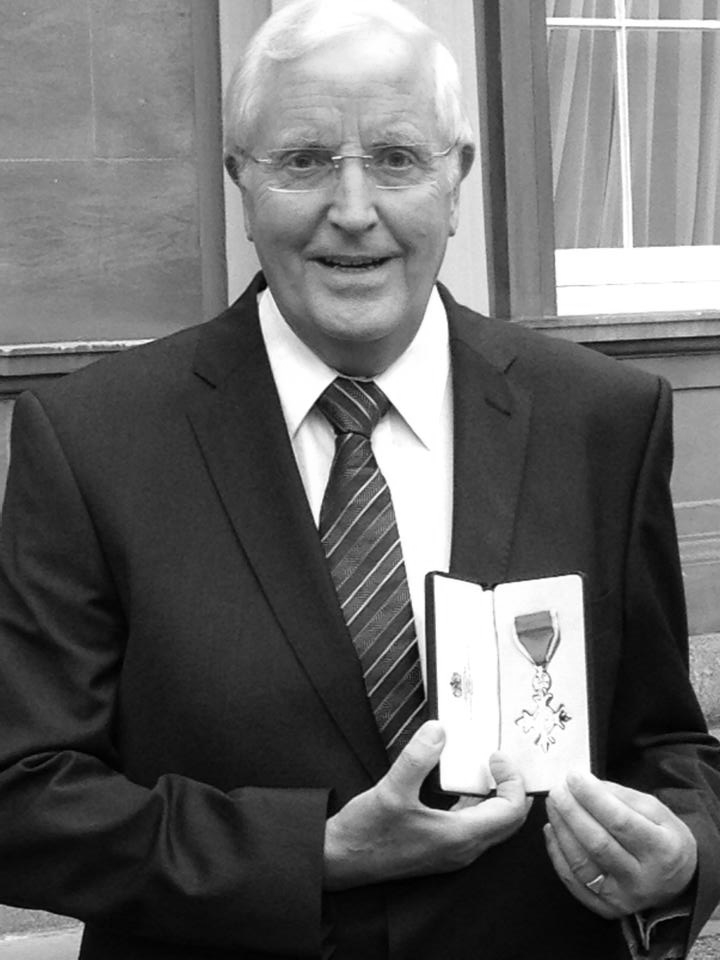
Richard Talbot

The profile of Richard Talbot reflects life of being a child following the end of the Second World War a period of difficulties and a ‘make do and mend’ philosophy.’ It identifies the ingenuity of young children with little or no pocket money. It also illustrates how as a young child Richard, along with his two brothers had to help with many household chores including fetching coke from the gas works on a Saturday with just an old pushchair to carry it back home with. All this with no TV, only an old radio, just a coal fire so no central heating, toilet down the yard which until the age of around nine was a Duckett lavatory until water was piped down the yard to provide a flush toilet.

Author's books

exe 2 The Abbots Bromley Murder 1857

£3.00

What was known as the Abbot’s Bromley Murder commenced in May 1857 at the Coach and Horses Inn, situated in the village of Bromley Hurst, a short walk from Abbots Bromley. At the bar stood William Charlesworth, a farmer aged sixty-seven who had been to market to sell cattle and had money on his person. Two young men were also in the bar, George Jackson aged twenty and Charles Brown aged twenty-one. At around midnight Charlesworth left with a friend but were followed by Jackson and Brown who were overheard before they left that they were going to have some fun with him. Charlesworth and his friend soon went their separate ways. Charlesworth had not walked far before he was knocked face down by Jackson. Brown then turned the body over and searching his pockets found a purse containing a large amount of money.
In this case the press reports seem to focus on the serious state of mind of Jackson as he awaits his coming ordeal in goal at Stafford. The writer spends some time in explaining the state of mind of Jackson, the involvement of the prison Chaplin and the final visit of his family.
As customary on these occasions the streets were flooded with visitors, many from miles away and were excited at the thought until Jackson was led to the high platform and the noose placed over his head. Despite the involvement of the prison Chaplin to console Jackson and then the final visit of his family to say goodbye was traumatic and he could not be consoled.
As customary on these occasions the streets were flooded with visitors, many from miles away and were excited at the thought until Jackson was led to the high platform and the noose placed over his head.

exe 3 The Execution of Dr William Palmer.

£3.00

The final essay records in graphic details the activities of Dr. Palmer known later as the Rugeley murderer, a prolific murderer whose case has been well documented in the press, in books and TV series and the last recorded in a run of thee in this series of executions at Stafford is that of Dr William Palmer of Rugeley, one of the most prolific mass murderers of his time attracting national notoriety
Palmer first started to work as a dentist but changed to that of a Doctor. The major issue was that he was a prolific gambler and would do anything to clear his debts. and forged his mother’s signature to pay off creditors and took out an insurance policy on his wife, his brother Walter and a friend George Bate.
Throughout his trial, even up to his time at the gallows with the prison Chaplin he would not admit to murder. A great story and certainly one worth reading.

far 2 Penkhull Farm – Its life from the time of Domesday.

£3.00

Penkhull Farm was the largest of five farms that covered the area of Penkhull. This farm which has formed the basis of a major study of its life from the time of Domesday 1086 all of which is included in a ninety-minute video of its history from Domesday to the 1960s, but also and importantly of the last farmer in Penkhull, Doug Jarvis and his wife Betty. It is probably one of the largest essays available on this site amounting to twelve pages of well researched documents and interviews with photos on this site.

The farm situated in Garden Street, formally Farm Lane and previous to that Tittensor’s Lane and was listed as one of the ancient messuages in 1714 manorial survey. It went then by the name of Drarwell and was occupied by the Dale family. The Hearth Tax returns of 1665 refer to a Roger Dale, having property with five hearths.  Roger died the same year, leaving the farm to his son, Thomas, a bachelor, aged thirty-two. He later married Margeria Townsend, daughter of a wealthy local farming family, in 1672 which was not uncommon at the time. The parish listings of 1701 confirm a Thomas Dale, yeoman, as living in Penkhull aged sixty-nine. In the list of 1714, his son, also named Thomas, occupied the farm but died four years later in 1719, aged forty-five. His estate was left to his sisters, Elizabeth, and Maria. Between the years 1720 and 1781, both the farm and considerable copyhold land attached passed to the Alsager family of Alsager Hall, near to Congleton.

Almost every possible bit of historical information has been researched to provide a twelve-page essay of over seven-thousand words. To achieve this, the information from Manorial Surveys, extensive Manor Court Rolls covering many centuries have been utilised to the full, tithe schedule, reeve books, census returns, parish registers and other documents far too many to list here, a massive undertaking.

hea 1 Bucknall Isolation Hospital – its history.

£3.00

The Potteries, as an industrial conurbation consisting mainly of tightly knit groups of hovels, no sanitation, no clean running water and loads of cesspits plus the constant pollution caused by its native industry. Smallpox became almost a never-ending pandemic with no cure, the problem with the sick and dying became an unsolvable problem and the cause then still a mystery. It was not until 1798 that Edward Jenner discovered that a vaccination could prevent smallpox, but the reality was to get people, especially children vaccinated in the 19th century.

Stoke-on-Trent did not escape the infections, in fact it suffered badly because of its poor cramped accommodation, mostly owned by pottery manufacturers for their workers. For the vast majority of those infected the only accommodation was the workhouse where accommodation was limited to just a few wooden huts with a limited number of beds separated some distance from the main buildings. Care was provided by the odd female inmate who had suffered the disease previously and therefore immune from in getting it again. For this they would receive a payment of a few shillings or a half-bottle of gin. However, the one thing both had in common as the only way to stop its advancement was isolation.

So, from this position came the thought of Isolation Hospitals and the towns of Fenton, Stoke and Hanley combined to solve the problem. Longton did not join them. From this came the search for land isolated which was the all-important factor and finally accepted a large plot in Eaves Lane, Bucknall.

Through the years it treated thousands of patients for the districts who supported it. Later it became a hospital that catered for infectious dieses and finally a hospital for elderly people. Now it has become a large housing estate and all signs of its previous life no longer exists.

An important study for those researching early medicine and treatments in industrial towns.

hea 10 The Parish Hospital at the Spittals Workhouse – 1842.

£3.00

The title of the building over the entrance door reads – Parish Hospital of Stoke-upon-Trent 1842 and thousands must have passed its doors every day without a glance in that direction. Now the building is a listed Grade II to ensure its preservation as part of the original workhouse complex.

It was built because of the need for a hospital, not just for inmates of the workhouse, but also the people of Stoke who had nowhere to go for any form of treatment. It is now used as offices. An advertisement was placed for tenders in the Potteries Mercury to build a hospital, the first to be erected in the Borough of Stoke. The article gives a whole list of items require in the specification. During the first world war it was set apart as a military hospital and a number of photographs have survived of this time and included in the article.

Full details of its early life and the types of treatment offered is well worth a read and as such an interesting piece for the early years of hospitals.

hea 13 Chloroform trials at N.Staffs. Infirmary – Etruria.

£2.00

I discovered that it was only a matter of months that chloroform was demonstrated for its properties on humans in 1847 by Scottish obstetrician, Sir James Young Simpson.  The report stated that Simpson was the first to demonstrate chloroform, most likely to an audience of his peers. It was described as “this new and important anaesthetic agent – the peculiar powers of which produced insensibility to pain and used widely from the early 1850s.

However, my research proved that it was first discovered, not in Scotland as reported in medical papers but in Etruria at the Peoples Dispensary for the sick with a 15-year-old girl in 1848. Skill and care were required to differentiate between an effective dose (enough to make patient insensible during surgery). In fact, in December 1846 the Potteries Mercury which pre-dates the official published date of the discovery in 1847.


hea 15 The first use of Ether in the UK – at Etruria in 1842.

£3.00

This three-page document records a significant part that Ether played at the for North Staffs Infirmary at Etruria before which those requiring amputations went through the most agonising surgery with only alcohol as a way of lessening the pain as no anaesthetic had been discovered. Whilst searching the pages of the Staffordshire Advertiser for a totally different subject I came across a most interesting article relating to the first use of ether vapour as an anaesthetic for performing pain free operations as early as 1846 at what was the first North Staffs Infirmary at Etruria before the new one was built in Hartshill in1866.

This story tells how it was a dentist who observed a fellow dentist use nitrous oxide, or “laughing gas,” as aesthetic for a medical demonstration. Unfortunately, the patient awoke while under the aesthetic and he was booed off the stage. After Morton observed this, he consulted a fellow a chemist who suggested using sulfuric ether as anaesthesia for surgery.

For those studying medicine this is a factual story of its very first recorded use at Etruria in Stoke-on-Trent.

hea 2 Health Report for Newcastle under Lyme 1872.

£3.00

Filthy, unsanitary areas of Pool Dam and Seabridge of Newcastle like in 1872? describes areas of Newcastle under Lyme as filthy, unsanitary areas of Pool Dam and Seabridge perhaps of Newcastle like in 1872. Mainly small cottages and hovels all occupied at the time and occupied by the poor population of the town. It was reported to be entirely neglected by the Newcastle authorities with a filthy sewage stream or brook about ten feet wide running through the area of Pool. In time of flooding the water from the stream rose at least eighteen inches to flood nearby properties and in some of the adjoining houses together with the condition of the cesspools and privies loaded with excrement, leaking and horribly offensive, give rise to a large number of complaints from many of the inhabitants and classed as disgraceful.

The water supply was from wells sunk into the ground along saturated with the filth of generations upon generations of inhabitants. Some of these wells are said to be dry many times during the year. The attention of the Newcastle Corporation was reported as paying no attention to the area nor enforcing the rules regarding sanitation etc.

The main problem was that from 1738 the populations of the district had increased causing additional issues of water and sanitation. The areas covered for the stats are:- Tunstall, Burslem, Sneyd, Rushton Grange, Hanley and Shelton, Penkhull, Boothen, Stoke, Fenton and Longton and Lane End.

This report is a perfect study for colleges or people interested in Social History. Three x A4 pages.

hea 4 Measles in the Potteries in the 19th century.

£3.00

For children of measles, mumps and rubella in the middle ages and Victorian times caused considerable concern to medical professionals who rightly feared a major outbreak with terrifying consequences including the loss of life. Since 1796, when Edward Jenner an English country doctor introduced a vaccine for smallpox it has saved more lives worldwide than any other vaccine to date. However, in the case of measles in was not until 1963 that a vaccine became available to protect mainly children but also adults.

The use of historical data used in this article helps us to evaluate and understand this importance of vaccination today. It shows that every town in the potteries was affected by measles in epidemic proportions every few years during the 19th century.

hea 5 Medieval Leper Hospital St. Lloy at Trentvale

£3.00

The first century Saint Giles’ lived from about 650 to about 710 and was also known as Giles’ the Hermit and is the patron saint of lepers. This fact could in many ways have led to the possibility, that the church in Newcastle, dedicated to St. Giles’, was the founding body that created the hospital of St. Lloy only a mile south of the town situated at Trent Vale on the area of the A34. Sadly, there is no written confirmation of its connection because until 1807, St. Giles’ was little more than distant chapel of ease in the ancient parish of Stoke-upon-Trent and it’s that church of St Peter-ad-Vincula, which is recorded and not St. Giles’. Reecords state that it was the responsibility of the Parish of Stoke-upon-Trent, St Peter ad Vincula,

The location is now occupied by the University Hospital teaching buildings. It is here that once stood a hospital dating from around the middle of the 13th century. Documentary evidence of the hospital of St Lloy has been known for many years, but the exact location remained a mystery until 1985 when excavations to the west of the new hospital wards was being under taken. Here were two skeletons uncovered together with stone foundations and a few sherds of medieval pottery. No serious archaeological work was carried out and the site was covered over to enable a car park to be established. From this time, whatever secrets these finds held were to remain hidden for a further sixteen years.

Little written evidence no longer exists but what there is has been well studied and form the basis of this essay. Great read.

hea 6 North Staffs Infirmary – from 1802 the one at Etruria.

Original price was: £10.00.Current price is: £4.00.

The first hospital hospital for Stoke opn Trent was situated in the area known as Etruria from 1802. There is a detailed account of how the hospital met the needs of the area discussed and number of working classes families requiring treatment. Much of the research carried out for this article proves a good insight to medical treatment as well as the hospitals function and finances and the important role that  Mr Wedgewood played throughout its life. Wedgewood played throughout its life. Like many properties nearby the hospital started to suffer badly with subsidence which created some urgency in locating a new site away from the industries of the area.

A informative account of its life until it was replaced by a totally new facility with a new name Royal Stoke University Hospital.

hea 7 Sanitary conditions of the Borough of Stoke-upon-Trent 1872.

£3.00

The inspectors reports identified Penkhull where several privies, were imperfectly covered with stone slabs and full and overflowing, the liquids running over the ground or down the gardens.
Stoke town complained of the water supply of Penkhull was also a serious problem because of its height and reported that it had little pressure to work the pumps in the case of a house fire. Other parts of the township are included such Boothen which is described as entirely neglected with regards to the removal of nuisances, and the drainage is defective. Privy nuisances abound everywhere throughout the hamlet.

hea 8 Stoke and Wolstanton workhouse population 1851-1891.

£6.00

Stoke and Wolstantion workhouses population. A study of the trends within the inmate population of both Stoke and Wolstanton workhouses and their causes.

This essay is twenty-seven pages long and containing nearly twelve thousand words. It is one of my major studies on the poor law of Stoke-on-Trent with two workhouse one at Stoke south, the Spittals operated  under the Stoke upon Trent Poor Law Union and the other in the north under the Wolstanton and Burslem Poor Law Union called Chell workhouse. The statistical information is extracted from the census enumerators returns and is an important ingredient into the study of Poor Law and for the purpose of an accurate analysis. The data extracted presents statistical information upon which conclusions are drawn on each workhouse illustrating areas of conformity and the differences found. Each entry was meticulously copied from census enumerators returns directly into spreadsheets where an analytical approach gives up their secrets to identify facts, figures, and trends. This contextualised data provides the means of assessing both the social history perspective and the influences of the Local Government Board and guardians of the poor placed into their care.

The period reflects that of six decades for the Stoke and Wolstanton Workhouses (1851, 1861, 1871, 1881, 1891, 1901) providing a prospective between two locations situated six miles apart but serving one industrial conurbation. The findings will be evaluated for the relevant years (1871-1901). The 1851 census will be used as a benchmark for this data.  Stafford and Newcastle-under-Lyme workhouse figures for 1881 will be used as a comparison. It is argued by Goose that despite the census returns are only factual once in every ten years that in fact variations during that period can be considerable producing a very different set of figures:

The Census returns provide us with information at one fixed point in time a perfectly valid historical perspective in its own right but one that masks the considerable coming and goings that the admissions register reveal, either through seasonal fluctuations or because of the activities of incorrigible individuals. As the census will capture higher proportions of long-term residents, it will undoubtedly tend to understate the proportions of individual working age, which feature in greater numbers in the admissions registers but who individually remained in the workhouse for much shorter periods.

This is a short evaluation of what it is all about, not only is it an insight to life in the workhouse system of the time but the basis for a student to formulate their own conclusions of what trends and qualities that each workhouse shared etc. Make a great project for a local history club.It is a perfect example for 6th form or university humanities studies. Also a great asistance to tutors.

This essay is ten pages long and a huge word count of over 12,000 words.

hea 9 The history of the North Staffs Infirmary at Hartshill from Etruria.

£5.00

Following the long struggle to overcome the serious stability of the Etruria buildings caused by industry with smoke and subsidence followed by an even longer struggle and different opinions a site at Hartshill was chosen belonging to the Mount estate and was subsequently purchased from Mr. Frederick Bishop, Solicitor of Hanley.
The foundation stone was laid on the 23rd of July 1860 by Sir John Heathcote, MP, the money being raised by a gift from the Prince Regent, out of the revenues of the Duchy of Lancaster and a legacy of £1,000 bequeathed by Mr John Rogers of the Watlands. The expenses of the additions were principally defrayed by a fancy bazaar held at Newcastle which realised the sum of £940 and with the additional receipts of an oratorio held in the new parish church of Stoke (opened in 1830) which yielded the sum of a further £800. Mr John Tomlinson of Cliffe Ville, at Hartshill displayed great zeal in establishing a firm start of this new Infirmary.
It was a time before the NHS and government funding, so as an ambitious product the finances depended upon the potteries folk to support this project on the principal it was a public hospital. Factory workers agreed to a few pence stopped from their wages, all churches had a special Infirmary Sunday with special services and the hope of more generous giving – all going to the hospital funs.
It also depended upon numerous benefactors who would pay the cost of the building of additional wards and operating theatres of which all would display the names of the benefactor responsible.
All this went on for nearly 100 years until the NHS took over the responsibility of all hospitals in July 1948. Since this date the hospital went from strength to strength both in its structure but also the medical services it provided. 11 x A4 pages and many photographs and nearly 5,000 words

inn 2 The Beehive Inn, Honeywall.

£3.00

The Beehive was formed out of three old cottages set in a row of back-to-back working class terraced houses which In all probability a row of workers cottages built by Josiah Spode at the end of the 18th or early 19th century for his workers. The location is shown on Hargreaves’ map of 1832.

Viewing the census of 1841 provides little to indicate there being any Inn at the site.  By 1851 the census however does list a Thomas Howell as a greengrocer and beer seller. In simple terms, he would have had a little greengrocer’s shop, and at the same time, probably had a couple of hand pumps, one for Mild and the other for Bitter beers, both for consumption off the premises. It is from here that the residents of the nearby houses would fetch the beer in a jug after a day’s work to have with their evening meal. The owner would be unable to sell spirits only beer or ale. Thomas was born in Eccleshall, and was married to Hannah, who was recorded in 1851, aged 62, and came from Oldham. They both probably came to Stoke to find work and met locally. They employed a servant, Elizabeth Cook, a local girl, aged 21.

1 2 3 8

Select at least 2 products
to compare