
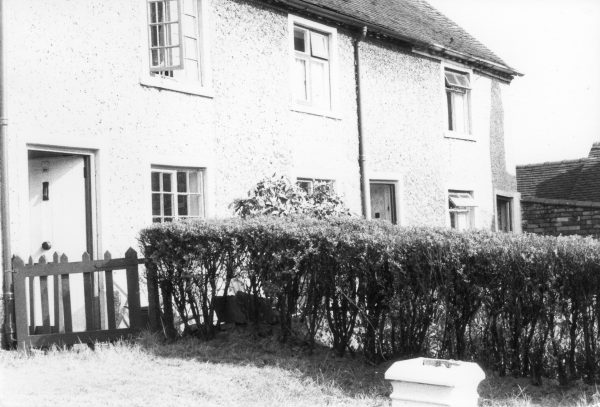


The land discussed here was Doody’s messuage comprising of all the land and other properties from between Kirkland Lane and St.Thomas Place.
A long barn stood facing Penkhull New Road. This was converted by Spode into ten small terraced houses, going by the name of Ten Row. There was another large property, standing back from the highway and facing St Thomas Place. This now forms four cottages converted from one. Unfortunately, the records are not very conclusive. It could have been assumed that this building, long and narrow was a barn or a group of stables, but evidence from the manor court rolls point to the fact that it was more likely to have been one dwelling house owned by Thomas Doody.
A further entry then provides the necessary evidence: a dwelling house has for many years been subdivided into and occupied as four dwelling houses, which servants belonging to the family of Josiah Spode and his late father now deceased. This conversion must have taken place after 1811 and before 1827. Further evidence of this is contained in records for November 1858 when the owner James Dean finally paid off the mortgage on the cottages: All those four several dwelling houses situate in Penkhull, lately converted out of a certain dwelling house known as Doody’s Messuage. The next record is dated June 1899 when the court records make note of the fact that Richard Nicholls, a timber merchant from Stoke had died the previous year.
The 1841 census records Richard Nicholls, By 1851, Richard senior was listed as a grocer from Stoke who with his wife Anne, aged 53, had handed over the timber business to his son Richard. Twenty years later in 1871, Richard junior was the only son left at home living with his widowed father. From the document dated 1899 the row of cottages was purchased at some date before then.
Three A4 pages. This illustrates how Penkhull started to develop from the early 1800s.


Reviews
There are no reviews yet.