
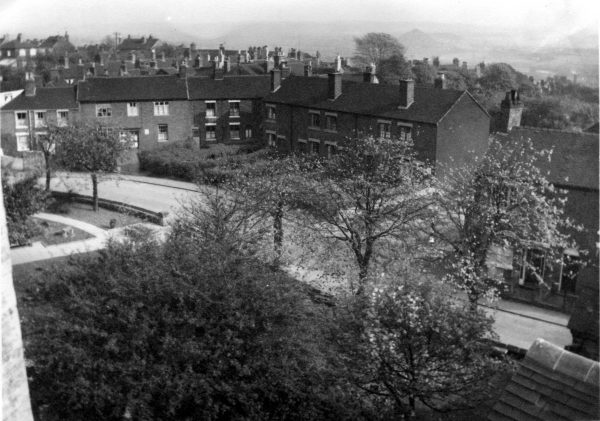


Because of the state of illness and deaths within the district of Stoke-upon-Trent a sanitary inspection of 1872 forms the basis upon which this report was compiled. Over a period of a couple of years Penkhull History Society has been examining the Annual Reports on Health and Sanitation for the latter half of the 19th century. The class examined a number of Government Inspectors Reports on subjects such as, local mortality and causes, employment of children (three reports) National Archives correspondence, where all relevant data has been selected and used to illustrate the conditions that people lived in around one hundred and fifty years ago. What is uncovered beggars belief of how our ancestors lived in such conditions. In fact, the group were disturbed by the number relating to Infantile Deaths under the age of one amounted to 53%, that is more than one in two never reached the age of one year.
The report included the villages that formed the Borough of Stoke commencing with Penkhull wheremany of the houses were reported as defective in respect of ventilation and subjected to the same causes of illness and death that appeared in all the other towns of what is now the City of Stoke-on-Trent. The surveyor informs in writing his report that the only part of the village that is cared for is to the east of the church, (Rothwell Street) the side which drains down Penkhull New Road into the London Road.
Those named with very severe issues were East Street, Manor Court Street
On the other side of the churchyard, East Street now Rothwell Street, cottages there were several privies, entirely were imperfectly covered with stone slabs and full and overflowing, the liquids running over the ground or down the garden. They must be highly offensive, as well as dangerous in the summertime.
The water supply of Penkhull was also a serious problem because of its height and reported that it had little pressure to work the pumps in the case of a house fire. Boothen is described as entirely neglected with regards to the removal of nuisances, and the drainage is defective. Privy nuisances abound everywhere throughout the hamlet. The water supply of Boothen was very defective, the inhabitants obtaining their water from superficial wells which are often dry and the water from which is said to be obviously contaminated in the summer season, or from a public spring which is liable to be contaminated with sewage.
At the further end of the hamlet, opposite the Plough public house, there lay, more or less scattered upon the surface of the roadway, a large heap of ashes, refuge, and filth, which must have been accumulating there for many a year or even decades. There was no Board within the borough that had any control of the roadways in Boothen. They were reported as being in a wretched condition.
Other parts of the borough are also mentioned, all have the same issues as many other areas of N. Staffordshire. Well worth a study.



Reviews
There are no reviews yet.