


The first century Saint Giles’ lived from about 650 to about 710 and was also known as Giles’ the Hermit and is the patron saint of lepers. This fact could in many ways have led to the possibility, that the church in Newcastle, dedicated to St. Giles’, was the founding body that created the hospital of St. Lloy only a mile south of the town situated at Trent Vale on the area of the A34. Sadly, there is no written confirmation of its connection because until 1807, St. Giles’ was little more than distant chapel of ease in the ancient parish of Stoke-upon-Trent and it’s that church of St Peter-ad-Vincula, which is recorded and not St. Giles’.
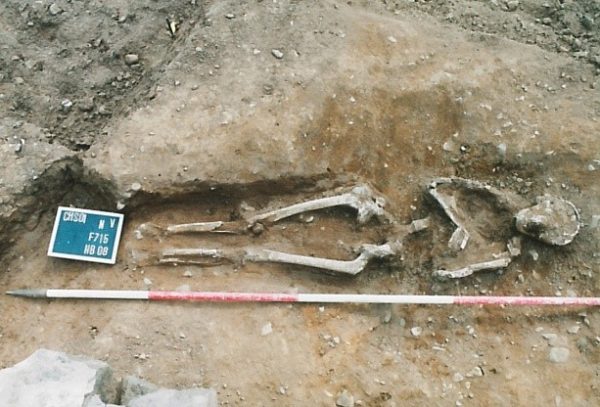
The location is now occupied by the University Hospital teaching buildings. It is here that once stood a hospital dating from around the middle of the 13th century. Documentary evidence of the hospital of St Lloy has been known for many years, but the exact location remained a mystery until 1985, when excavations to the west of the new hospital wards was being carried out. Here were two skeletons uncovered together with stone foundations and a few sherds of medieval pottery. No serious archaeological work was carried out and the site was covered over to enable a car park to be established. From this time, whatever secrets these finds held were to remain hidden for a further sixteen years.
There has been considerable confusion over the hospital’s dedication. By 1266, there was a hospital recorded at Newcastle, dedicated to St. John the Baptist when in that year the master and the Crown granted brethren protection for three years. By 1437, it was reported that it was dedicated to St Louis and St John followed by St Louis, and they proceeded as alternative dedications in 1454/9 and 1460 although St Eloy was given as the sole dedication in the years 1485 and 1546. In 1485, 1516 and 1551 it was referred to as St Leo.
The Chantry Commissioners in 1546 reported that the rent of certain lands amounting to £2 13s 4d a year was paid to a priest called the Master of the Hospital of St. Lloy. The incumbent did not know the name of the founder or the purpose of its foundation. This suggests that it had been founded for several hundred years. Great piece of writing and worth of a read and again an important contribution to the growth of medicine in the area from such and early date.


Reviews
There are no reviews yet.