


The Potteries, as an industrial conurbation consisting mainly of tightly knit groups of hovels, no sanitation, no clean running water and loads of cesspits plus the constant pollution caused by its native industry. Smallpox became almost a never-ending pandemic with no cure, the problem with the sick and dying became an unsolvable problem and the cause then still a mystery. It was not until 1798 that Edward Jenner discovered that a vaccination could prevent smallpox, but the reality was to get people, especially children vaccinated in the 19th century.
Stoke-on-Trent did not escape the infections, in fact it suffered badly because of its poor cramped accommodation, mostly owned by pottery manufacturers for their workers. For the vast majority of those infected the only accommodation was the workhouse where accommodation was limited to just a few wooden huts with a limited number of beds separated some distance from the main buildings. Care was provided by the odd female inmate who had suffered the disease previously and therefore immune from in getting it again. For this they would receive a payment of a few shillings or a half-bottle of gin. However, the one thing both had in common as the only way to stop its advancement was isolation.
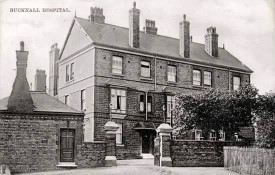
Writers of the history of Bucknall Isolation Hospital commence when it was opened in 1886, but my research unfold a story of campaigning, and tiresome negations for no less than nine years before it admitted its first patients. It was not until June 1877 that the Local Government Board in London started to look for a solution.
The story unfolds that it was Hanley moved first the idea of a proposed Joint Hospital Board for a combined isolation hospital to accommodate no more than six males and six females on a one-acre site off Eaves Lane, Bucknall. This joint venture included Hanley, Stoke, Fenton and Longton. However, following many arguments between the towns Longton decided to bury its dead in sand stating it would erect a temporary wooden isolation ward as and when it was required.
Each year or the following year there appeared fresh outbreaks of the disease, and with them came fresh issues of conflict between the three Boroughs. In what proportion would the costs be shared; complaints from the residents of Bucknall for with such a high death rate on their doorstep they objected claiming their churchyard would soon be full; in what proportion of representation from each town would be represented on the Board of Management? Finally, in 1882 a new six-acre site was purchased at a cost of £908. So, if you’re interested in how medicine developed in North Staffordshire reading the original research never seen before is well worth a read. Covers 3 x A4 pages and photographs.


Reviews
There are no reviews yet.