

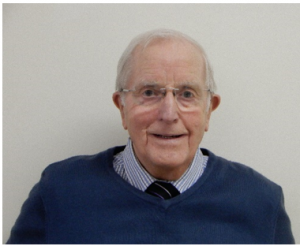
 Education from the age of four.
Richard was born in an area almost on the edge of Boothen, in Fielding Street, Stoke and as a child he first attended from the age of four, Field House Nursery in London Road, Boothen exactly opposite to where Boothen Church once stood.
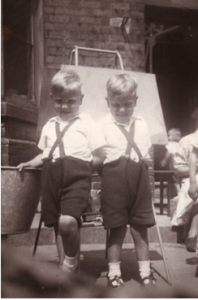 From there, along with his twin brother John, they just crossed over the road to what was Boothen Infants School under the headship of Miss W. Wayte. Richard only has a few memories of the infants, one of which was Miss. Wayte catching him in one of the old air-raid shelters used as a store for the P.E..equipment for which he received a smack on the top of his leg. Certainly not allowed today. Surprisingly later in life when he attended St.
Peter’s Church in Stoke, he became quite good friends with Miss Wayte who also attended Stoke church and for years was the parish treasurer.
From the age of around seven he crossed over the school playground to All Saint’s Junior School, just across the playground where he would enjoy the next four years of education. Richard has recalled his extensive memory of his time at Boothen in a couple of articles published first in The
Way We Were appearing in the Sentinel newspaper. Following his four years at Boothen Junior School he now feels that despite enjoying every minute at the school and was in the A stream the results in the annual school reports he fell below half-way and so often comments always made note “Richard could do better”.
From there he went to St. Peter’s Boys secondary modern school in Boothen Old Road which stood in the shadow of the Boothen End at Stoke FC Victoria Ground. Here Richard was at his happiest enjoying helping out during the six-weeks holidays in looking after the school allotments. He became a class monitor, milk monitor and in charge of ringing the school bell at the end and start of lessons as well as play time. Even found time to put the kettle on the gas stove in the staff room ready for making tea when the staff arrived. In fact, the staff and the head teachers were all remarkable, despite giving out six-strokes of the cain when necessary.
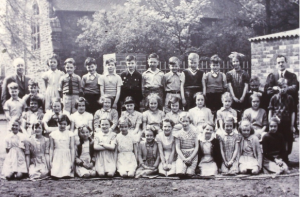 The biggest surprise in his final year was at the annual prize day, with some parents attending. Standing there watching all the academic, then sports and other achievement, prizes presented and regretting that he never had a prize at school. Then his name was called out – The staff considered that a new prize should be awarded for the boy who excelled in Services to the School. And there Richard walked proudly to receive his with all the others the familiar comment stood out ‘could do better’. Upon leaving school he became an apprentice electrician at a company in Stoke, Barnett and Soans, in South Wolfe Street. Not too happy there although he took on more jobs and progressed well from the initial jobs of sweeping up, fetching the chips on a Friday and stocking up the coke boiler on a regular basis. However, Richard wanted more of a challenge and not happy as he was continually referred to as Talbot do this, Talbot to that! Never once was my first names used.
From there Richard had a number of jobs, each time lasting for a few years but then wanted a move to something more challenging. At last, at the age of around mid-thirty-something happened – he purchased an old run dawn letterpress printer in London Road, where he immediately modernised the shop and improved the printing equipment to litho-offset. Richard ran this company for almost forty years retiring at the age of fifty-eight.
Richard’s early interest in history started from the age of eighteen following his reading of a small book written by the then Vicar of Penkhull, Rev. V. G. Aston on the History of Penkhull published in 1942 to celebrate the hundredth anniversary of the building of St. Thomas’s. It was his writing that was the inspiration that led, encouraged, and challenged him into researching and writing several books, the first in 1969. He was later accepted as a mature student by Keele University gaining
M.Phil.
Following the publication of his major work entitled ‘The Royal Manor of Penkhull’ in 2010, the largest book ever published in North Staffs with over 300,000 words Richard was accepted by the University of Leicester to study for his PhD in Victorian Poor Law which was his greatest challenge in his life and something he is very proud of after leaving school at fifteen with no ‘O’ levels.
 During all these years prior to University Richard became well known as an amateur historian writing articles for publication, presenting history programmes on Radio Stoke as well as public talks. He has also made significant contributions to the local community of Stoke-on-Trent especially with his campaign to restore and re-open the 1929 Art Deco Gaumont cinema in Hanley into the Regent Theatre, is original name. It was achievement along with so many other local objectives which were recognised by the award of an MBE. Presented at Buckingham Palace by the then Prince of Wales, who himself is a keen historian.
Despite being retired for around twenty years, Richard still maintains a keen interest in history both giving talks, publishing of articles and teaching to a local history class based in Penkhull for around twelve years.